
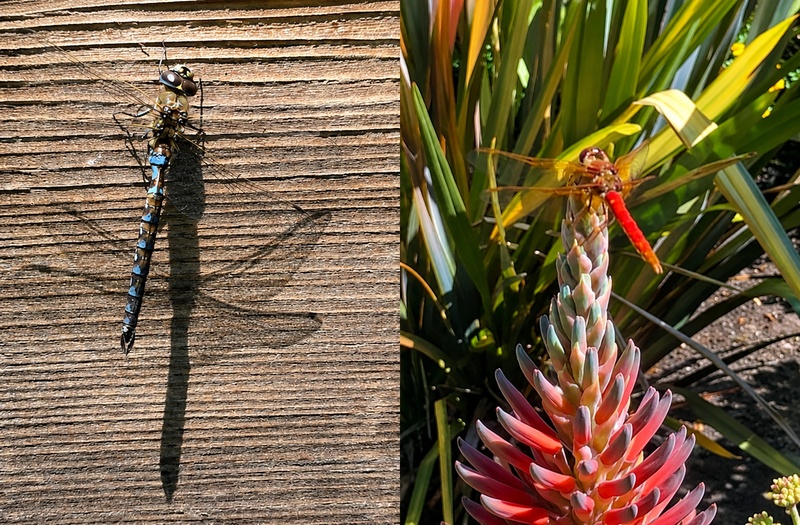
I’m waiting for the dragonflies. Darners, the long-bodied, fast, almost hawk-like dragonflies. Skimmers and Dashers, the ones you most often notice sitting on a twig. They perch, launch, and return over and over. They are blue, orange, and red and have patterned wings. Meadowhawks, these small dragonflies are the last to emerge and they stick around through Autumn. The males are crimson and the females yellow, orange or tan.
All dragonflies have four wings that provide extra control, more lift at low speeds, and superior maneuverability.
The dragonflies are ancient living fragments of deep time whose ancestors flew over the ponds, marshes and creeks where they were born and lived underwater most of their lives. The earliest dragonflies flew in the Carboniferous forests 300 million years ago, some with wingspans over two feet. They are older than birds, mammals, and even dinosaurs.
There’s something almost ghostlike about the first dragonflies on the coast. They appear before the season feels ready, like a signal that the hidden underwater world has quietly turned the page.
Dragonfly nymphs develop a taste for mosquito larvae while they mature in ponds, marshes, and backwaters. They spend months and even years under water where they breathe through gills and hunt for mosquito larvae, tadpoles, and even small fish. This is the real life of dragonflies. The glittering, acrobatic adult that flies through the air is no more than the final act, lasting only a few weeks or months.
When the nymph is ready, it climbs out of the water, often at dawn, onto a reed or grass stem. Then something almost mythic happens. The skin splits behind the head. The adult dragonfly pulls itself out, soft and pale. Wings unfold, veins fill with fluid, and the body hardens in the morning air. What’s left behind is the empty shell clinging to the plant like a ghost of the underwater life.
The dragonflies will soon be flying in my Mendocino meadow. They are fierce predators of the mosquitoes who’ve been hatching as it grows warmer. A dragonfly eats from a few dozen to over a 100 small insects every day, mosquitoes, gnats, flies and even a few of its own kind.
Like toy airplanes, dragonflies slice through the air with their cellophane wings leaving invisible shards to be carried away by the butterflies who pitch and roll under the weight. Dragonflies need warmth to fly. They perch on whatever they can find with their wings angled wide to catch what little sun breaks through the marine layer.
At midday the sun breaks through and dragonfly activity explodes. They patrol territories over ponds, meadows, and even sheltered coastal bluffs. Flight is precise and astonishing, hovering, darting, even flying backward. They are among the most efficient hunters on earth, with success rates over 90%.
In the afternoon the feeding continues. Males defend their territories. Chases and aerial duels are common. Mating occurs in flight. At night they roost in vegetation, sometimes communally, sheltered from the cool marine air.
A dragonfly’s life is almost philosophical in structure. It spends years in darkness and water then emerges into the light to spend a brief, intense life of motion and reproduction.
Beautiful as they are, dragonflies are driven, hungry, temporary, and ultimately extinguished. Here on the Mendocino coast we are accustomed to brevity, light, and the crossing between worlds, so they fit in like seasoned locals.
You are made of almost nothing
But of enough
To be great eyes
And diaphanous double vans;
To be ceaseless movement,
Unending hunger,
Grappling love.
Link between water and air,
Earth repels you.
Light touches you only to shift into iridescence
Upon your body and wings.
Twice-born, predator,
You split into the heat.
Swift beyond calculation or capture
You dart into the shadow
Which consumes you.
You rocket into the day.
But at last, when the wind flattens the grasses,
For you, the design and purpose stop.
And you fall
With the other husks of summer.
“Is it a dragonfly or a maple leaf / That settles softly down upon the water?” asks Amy Lowell in “Autumn Haze,” a poem from her book Pictures of the Floating World.
The Shape of Air, A short story
There is a way the air holds things.
Not just sound, not just wind, but memory, weight, a kind of invisible architecture.
Most people move through it without noticing, as if it were nothing. But that is because they are heavy. They fall through it, like stones through a dream.
Some learn its shape. Yes, the air has a shape.
You notice it most with the dragonflies.
They arrive before the season feels ready, one or two at first, cutting across the gray Mendocino sky as if they are writing something no one else can read. They do not flap, they negotiate with the air. Their wings move, yes, but what they ride is something else, something already there, waiting.
Watch them the way you read a line of poetry, not just what is said, but what is carried between.
At the pond beyond the headlands, where reeds bend and straighten in the slow pulse of coastal wind, look how they hover. They stop, suspended, as if pinned to an unseen thread. They dart, precise as an arrow and catch what can’t be seen: a midge, a gnat, a fragment of motion.
The air is not empty.
It’s crowded with intentions.
Birds know this in different ways.
The ravens are first, heavy but cunning, riding thermals that rise like secret ladders from the cliffs. They don’t fighten the wind; they lean into its arguments. One tilt of a wing and the invisible becomes visible, lift becomes one long, effortless glide.
Next come the swallows. They stitch the sky with arcs so quick they seem like corrections, edits to the air itself. They don’t hover. They write in cursive, erase, and write again.
Higher still, an osprey, pausing midair, trembles against gravity, reads the water below through the language of the air, plunges, breaks, and then two worlds collapse into one.
Everything is connected through something no one sees.
At night, the moths take over.
They come in soft spirals around the porch light, orbiting an idea they can’t touch. Their wings make almost no sound, a tiny whisper like pages turning in a room where no one is reading.
Notice how they correct themselves constantly, drifting, returning, adjusting to currents too subtle to name. The air moves them, but they move the air too, in small, reciprocal gestures.
The bats scatter out of their hive-like homes when the night turns pitch black. They detect tiny insects in the dark. With their voracious appetites they eat thousands of mosquitoes and other small insects, even more than the dragonflies.
The owls, solitary hunters, join the bats as the night progresses toward dawn. Carnivorous predators, they split the air as they rocket toward their prey.
Nothing is still. Stillness is movement in place.
The dragonflies teach us more about the air than the others.
One afternoon, when the fog pulls back just enough to let the sun sketch outlines on everything, the grasses, the fence posts, your own hands, you might see one perched at eye level.
Blue, almost impossibly so, a body like a line drawn once and never corrected. Wings held out flat, four panes of trembling glass.
Lean closer.
The wings are not symmetrical in the way you might expect. The front pair and the back pair shift slightly out of phase, a quiet disagreement. And in that disagreement, something miraculous occurs. The dragonfly doesn’t fall.
It hovers. It rewrites gravity.
Maybe then you will begin to understand.
Air is not absence. It’s resistance, permission, memory of motion. It holds every wingbeat that has ever passed through it, every migration, every fall interrupted by flight.
It remembers.
The dragonflies, newly risen from water, seem to know this instinctively. They’ve lived in another element, dense, enclosing, slow, and now they enter this second world not as strangers, but as inheritors.
They do not conquer the air, they learn to understand it.
One evening, just before the fog returns to reclaim the edges of things, stand at the pond and you will feel it yourself.
That slight push against your skin. The lift, almost imperceptible, when you raise your arms. The way your breath moves outward and shapes the space in front of you.
Imagine the air as water. Not metaphorically, but physically, something with currents, pressure, hidden flows. Something you can learn to move through, not just in.
For a moment, only a moment, you feel lighter. Not lifted, exactly, but less fixed, as if your boundaries are negotiable. As if you, too, might hover.
The dragonfly returns the next day, or another like it. There’s no way to be sure.
It pauses in front of you again, suspended in that impossible stillness that is not stillness at all.
Between you is the air, shaped, alive, carrying both of you in different ways.
No need to reach out. Some things need not be touched. They are already paired together.
That quiet exchange, without words, without gesture, teaches something the heavy world rarely allows. What holds us up is not always visible. What surrounds us is not empty. The air, like water, has a shape. And, some beings, the dragonflies and butterflies, the birds, the drifting moths, the bats, the owls, and perhaps even you have learned to read it.
I really really like the first part of your dragonfly story. Thank you