
I discovered books at a young age. I knew immediately there was something important between the covers, something to be decoded. I learned to read and I was hooked. I grew up in a small rural town. There were no bookstores. I discovered I could order paperback books through the school that arrived in a big box once a month or so. For every book I read, I got to paste a gold star on a chart attached to the wall. I soon filled my chart. By then the stars were no longer necessary.
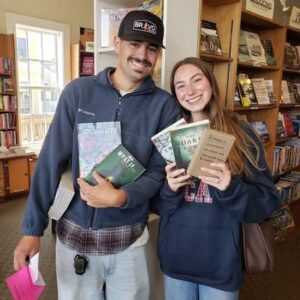
This past Saturday along with five other writers I greeted dozens, maybe hundreds, of customers who walked into Gallery Books in Mendocino to celebrate Independent Bookstore Day. Some knew about the event in advance and some were surprised. Everyone, as far as I could tell, was happy they came. There was a scavenger hunt, a Golden Ticket hunt, and a variety of other fun things to do not the least of which was to check out the incredible selection of books and meet some of the authors.

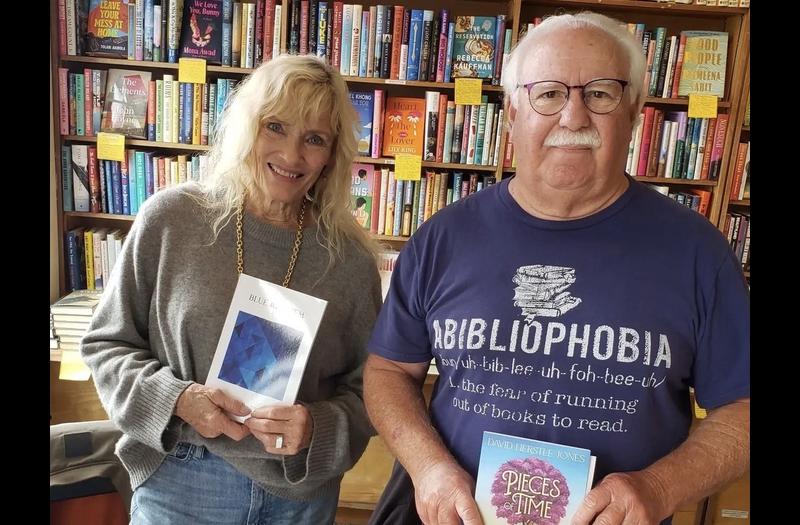
Guest Authors Joseph Tappero and Patty Joslyn
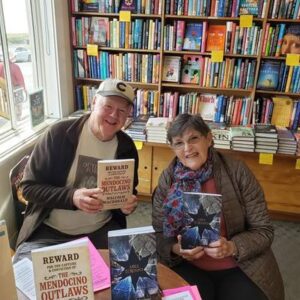
Guest Authors Malcolm Macdonald & Fran Schwartz
Independent Bookstore Day is highly successful, serving as one of the busiest and most profitable days for independent booksellers nationwide. With over 2,000 stores participating annually this year, the event helps generate sales, increases customer awareness, and engages the community in driving a renaissance in local, physical bookshops.
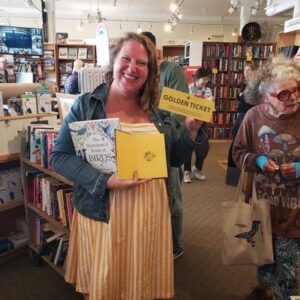
Golden Ticket winner
I fondly remember the great independent bookstores where I found the authors and poets and thinkers and friends that changed my life: Cody’s in Berkeley, Kepler’s in Menlo Park, City Lights in San Francisco, and, for over fifty years Gallery Books in Mendocino, where just recently they’ve even sold a couple of books that I wrote. Who’d da thunk it?
No matter how many books I read, I’ll never make a dent in the unimaginable number I might have read, in Borges Library of Babel. But, I will have the satisfaction of the ones I did get to.
In 1939 there were an estimated 10,640 new titles written. (The New Yorker) In 1950, eleven thousand new titles appeared, according to Publishers Weekly; in 1970, the number was thirty-six thousand, a threefold increase. Today, something like three million books are published every year, including self-published e-books that are available only on digital platforms.
You can support your local independent bookstore by purchasing your hardcover and paperback books at the store. If you purchase e-books, Bookshop.org supports local, independent bookstores by channeling over 80% of its profit margin to them, providing an ecommerce alternative to Amazon. It gives 30% of the cover price to specific stores designated by customers and distributes 10% of regular sales into a shared pool for all participating independent stores.
According to Kristen McLean, an industry analyst, two-thirds of the books released by the top-ten trade publishers sell fewer than a thousand copies, and less than four per cent sell more than twenty thousand.
Whether writing or selling books, it’s a tough business. Independent bookstores were on the decline as the chain stores (B. Dalton. Waldenbooks), superstores (Borders, Barnes & Noble), and online stores (Amazon, etc) tore into their business at about the same time that Jaws ripped through the movie industry.
But, “Indies” have staged a “triumphant comeback,” with a 70% increase in the total number of independent bookstore locations since 1970 according to Straight Arrow News.
Why, you might ask, do we need independent bookstores?
“One [reason] is the obvious benefit of being able to fondle the product. Printed books have, inescapably, a tactile dimension. They want to be held. ‘Browsing’ online is just not the same experience. For that, you need non-virtual books in a non-virtual space. The level of customer service is another benefit. Salespeople today tend to be book lovers themselves (historically not always the case), and they can recommend a new book or help you find a book whose title you have forgotten. The chief rationale offered for brick-and-mortar bookstores today is that they are community-building spaces. They are practitioners of bibliotherapy. They introduce people to books that will help them overcome grief or minister to confusions about life choices or personal identity. And the stores are fashioned to be neighborhood gathering places, like park playgrounds. They welcome everyone—toddlers, oddballs, and professors. They schedule author appearances and other events, often hundreds of them a year. Regulars drop in to chat about books.” (The New Yorker)
Your local bookstore is “local.” It helps support the local economy. What goes around comes around. This is something that seems to resonate more and more as the downside of big business, big tech, and big money incites a reaction against algorithm-driven culture.
In 2025 alone, 422 new independent bookstores opened, a 31% increase from 2024, thriving by focusing on community, curation, and in-person experiences, overcoming the rise of online retail giants. (Fast Company) The independent bookstore survives not by competing with Amazon, but by becoming something Amazon cannot be.
Independent bookstores are no longer just sellers, they are filters of attention. They play a role closer to editors of culture, curators of meaning, and gateways through the noise. In a world flooded with millions of titles, the indie bookstores matter more, not less, in the age of abundance.
[Photos complements of Rob Hawthorn]