
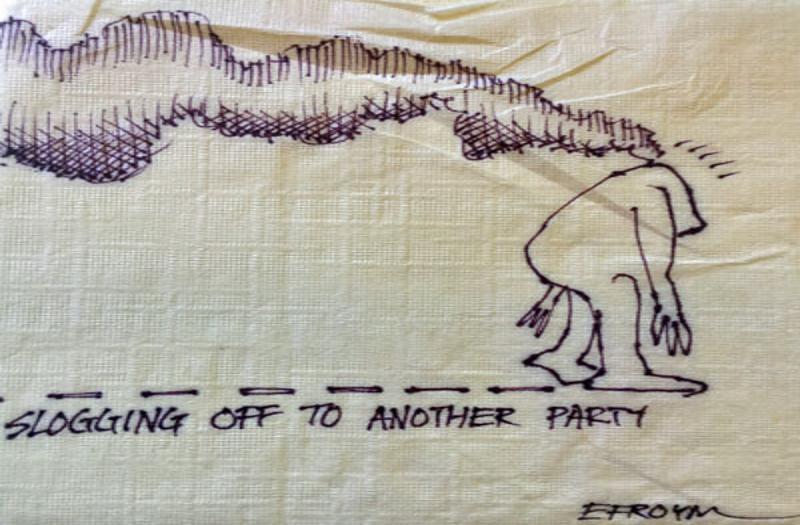
The meaning of life is that it ends … Franz Kafka
How do we live when life offers no clear script, and we still crave meaning? We can analyze, brood, knead the dough, and hope for loaves and fishes. We can ignore life’s existential angst and float in The Unbearable Lightness of Being as Milan Kundera calls it in his philosophical novel. We can slog through the heavy mud committed to some chosen purpose, perhaps a private love or some grand political vision. We can laugh and live inside the absence of meaning without panic.
Kundera’s novel is about four people who try to tackle this problem each in their own way.
- Tomas is a surgeon who seeks “lightness” through infidelity.
When his friends asked him how many women he had had in his life, he would try to evade the question, and when they pressed him further he would say, “Well, two hundred, give or take a few.” The envious among them accused him of stretching the truth. “That’s not so many,” he said by way of self-defense. “I’ve been involved with women for about twenty-five years now. Divide two hundred by twenty-five and you’ll see it comes to only eight or so new women a year. That’s not so many, is it?”
- Tereza, Tomas’s wife, seeks “heaviness” through a meaningful, committed love.
Tomas kept trying to convince her that love and lovemaking were two different things. She refused to understand. Now she was surrounded by men she did not care for in the slightest. What would making love with them be like? She yearned to try it, if only in the form of that no-guarantee promise called flirting.
Let there be no mistake: Tereza did not wish to take revenge on Tomas; she merely wished to find a way out of the maze. She knew that she had become a burden to him: she took things too seriously, turning everything into a tragedy, and failed to grasp the lightness and amusing insignificance of physical love. How she wished she could learn lightness! She yearned for someone to help her out of her anachronistic shell.
- Sabina, an artist and Tomas’s mistress, who embodies lightness in her flight from kitsch which Kundera defines “as a forced, sentimental aesthetic that masks the complexity and ugliness of reality” or, in other words, “the absolute denial of shit.”
Sabina’s initial inner revolt against Communism was aesthetic rather than ethical in character. What repelled her was not nearly so much the ugliness of the Communist world (ruined castles transformed into cow sheds) as the mask of beauty it tried to wear—in other words, Communist kitsch. The model of Communist kitsch is the ceremony called May Day.
In the novel Sabina leaves Franz, a lover who gets too close and tries too hard. Kundera describes how this affects Sabina:
When we want to give expression to a dramatic situation in our lives, we tend to use metaphors of heaviness. We say that something has become a great burden to us. We either bear the burden or fail and go down with it, we struggle with it, win or lose. And Sabina—what had come over her? Nothing. She had left a man because she felt like leaving him. Had he persecuted her? Had he tried to take revenge on her? No. Her drama was a drama not of heaviness but of lightness. What fell to her lot was not the burden but the unbearable lightness of being.
Until that time, her betrayals had filled her with excitement and joy, because they opened up new paths to new adventures of betrayal. But what if the paths came to an end? One could betray one’s parents, husband, country, love, but when parents, husband, country, and love were gone—what was left to betray?
Sabina felt emptiness all around her. What if that emptiness was the goal of all her betrayals?
Naturally she had not realized it until now. How could she have? The goals we pursue are always veiled. A girl who longs for marriage longs for something she knows nothing about. The boy who hankers after fame has no idea what fame is. The thing that gives our every move its meaning is always totally unknown to us. Sabina was unaware of the goal that lay behind her longing to betray. The unbearable lightness of being—was that the goal? Her departure from Geneva brought her considerably closer to it.
- Franz, Sabina’s idealistic lover who seeks meaning in grand gestures like the “Grand March” toward paradise on earth.
The fantasy of the Grand March that Franz was so intoxicated by is the political kitsch joining leftists of all times and tendencies. The Grand March is the splendid march on the road to brotherhood, equality, justice, happiness; it goes on and on, obstacles notwithstanding, for obstacles there must be if the march is to be the Grand March.
The questions Kundera poses in his novel are of particular importance in America today where kitsch grotesquely controls the top levers of government. In an interview with Ewan McEwann in Granta just after The Unbearable Lightness Of Being was published Kundera said:
“In my view, politics–in the sense of political parties, elections, modern politics–is unthinkable without kitsch. It is inevitable. The function of the successful politician is to please. He is meant to please the largest number of people humanly possible, and to please so many you must rely on the cliché they want to hear.”
Kundera uses two German adages that describe two different views of life (recurring or once only): “einmal ist keinmal” (What happens but once might as well not have happened at all. If we have only one life to live, we might as well not have lived at all.) OR “es muss sein” (“It must be”). Maria Popova in The Marginalian (“Milan Kundera on the Power of Coincidences and the Musicality of How Chance Composes Our Lives”) discusses the importance of Beethoven in the novel especially his String Quartet No. 16 Op 135 which you can listen to at the link below.
(Popova): Kundera places chance at the center of the love story unfolding between two people who believe they have chosen each other. Teresa — a romantic full of existential longing and Anna Karenina — is working as a waitress in a restaurant. One evening, a man looks up from his book to order a cognac. At that very moment, Beethoven comes on the radio. Long ago a string quartet had come to play in Tereza’s small town and had rendered Beethoven “her image of the world on the other side, the world she yearned for.” She takes it as a sign — Tomas must be the answer to her yearning. She goes on seeking other signs — when he charges the cognac to his room, she realizes his room number is the same as the street number of the house she grew up in. “Tomas appeared to Tereza in the hotel restaurant as chance in the absolute,” Kundera writes as he considers the psychological machinery of how we imbue such coincidences with meaning:
(Kundera) “Our day-to-day life is bombarded with fortuities or, to be more precise, with the accidental meetings of people and events we call coincidences. ‘Co-incidence’ means that two events unexpectedly happen at the same time, they meet: Tomas appears in the hotel restaurant at the same time the radio is playing Beethoven. We do not even notice the great majority of such coincidences. If the seat Tomas occupied had been occupied instead by the local butcher, Tereza never would have noticed the radio was playing Beethoven… But her nascent love inflamed her sense of beauty, and she would never forget that music. Whenever she hear it, she would be touched. Everything going on around her at that moment would be haloed by the music and take on its beauty.”
[Note: In the manuscript for the fourth movement of his String Quartet No. 16, Beethoven wrote the title “Der schwer gefasste Entschluss” (The Difficult Decision). Beneath it, he penned two short musical phrases with German text:
- “Muss es sein?” (Must it be?): A grave, questioning three-note motif in the viola and cello.
- “Es muss sein!” (It must be!): A faster, more affirmative three-note reply that forms the joyful main theme of the movement.]
Tomas initially uses “Es muss sein” to justify his return to Soviet-occupied Prague to be with Tereza, framing it as an inescapable destiny. However, he eventually realizes his love for her was actually “born of six laughable fortuities” rather than necessity. In other words, life is just a series of random events. He moves into a form of weight that he accepts, even quietly embraces while never fully escaping the knowledge of lightness.
Kundera shared Kafka’s vision of the individual’s struggle against a dehumanizing world. He also identified with Kafka’s sense of humor that captures the absurdity of the human condition independently of any political ideology. Kafka’s quote: the meaning of life is that it ends creates the tension between lightness and weight. Because life happens only once and then ends, it has no basis for comparison and no weight. It’s a sketch for a picture that will never be painted, a first rehearsal without a final performance.
Death provides a kind of frame for life. Without an end, life would be an infinite, repeating loop (I can’t help but think of William Blake’s The Mental Traveller), the heavy burden of Nietzsche’s Eternal Return. In a world where everything repeats, every action carries an unbearable weight of responsibility. In our world, where life ends, everything is “dead in advance” and thus “light.” (Light is how Richard Brautigan in The Galilee Hitchhiker) sees the world.)
For Kafka our mortality drives us to create something of significance before the end. For Kundera it is the source of the freedom and vertigo that give rise to life’s “unbearable lightness.” Rainer Maria Rilke, the Austrian poet, beautifully turns the idea of only once into meaning in his Ninth Elegy:
But because just being here matters, because
the things of this world, these passing things,
seem to need us, to put themselves in our care
somehow. Us, the most passing of all.
Once for each, just once. Once and no more.
And for us too, once. Never again. And yet
it seems that this—to have once existed,
even if only once, to have been a part
of this earth—can never be taken back.
The Unbearable Lightness of Being is IMHO a masterpiece although I’ve seen some criticisms. I suppose it’s not everyone’s cup of tea. I’m a coffee drinker but I avoid Kopi luwak like Sabina avoids kitsch (“the absolute denial of shit). If you are too lazy to read the book, an American trait related to the technological takeover of the 21st century, you can watch the movie on Prime Video. The movie is okay but the book is better. Isn’t that always the case?
Wasn’t Rilke Czech? He died in a small Swiss village near where I lived. Thank you for your blog!
You made my day by responding so quickly! I never know if anyone reads my blogs. As I’ve said at times, I write for myself to clear my head, reduce my stress, and engage in a form of meditation. However, it is gratifying to know that some do read what I write. Thanks. Much. And Rilke was a great poet, you nailed that part.
Prague was part of Austria-Hungary when Rilke was born so you got it right, sorry!