
You can’t see the forest for the trees.
The whole is greater than the sum of its parts.
The whole is other than the sum of its parts.
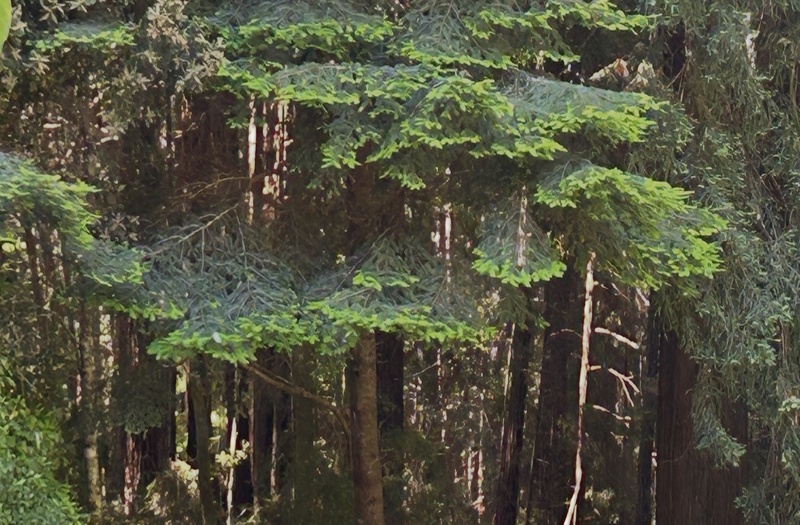
Tiered conifer boughs rise like terraces while the trunks vanish into shadow beneath them. Individual trees lose their distinctness from a distance. What you actually perceive is canopy, a continuous green mass, even though each tree is rooted separately, grows at its own rate, and competes for its own share of light. Only when you look closely do the individual trunks resolve out of what first appears as undifferentiated foliage.
Thoughts are like that. Most of the time what we’re aware of is something akin to the weather, a general mood, a hum of cognition, rather than discrete, isolable thoughts. It’s only in moments of close attention like when we write, meditate, or argue with ourselves that a single thought stands out the way a single tree trunk does when it rises out of the tangle.
Consider what’s going on underground. Trees in old-growth forests are frequently interconnected by mycorrhizal networks. They share nutrients and chemical signals. The appearance of separateness is partly an illusion. What looks like discrete individuals are nodes in something more continuous. Thoughts might be the same. Each one feels like its own discrete event, but they’re fed by the same roots: memory, mood, and associative brain meat. They constantly trade material with each other below the threshold of awareness.
A forest of discrete “trees” is a kind of reduction. The forest doesn’t experience itself that way. The same is true of a mind that insists on discrete “thoughts” rather than an interwoven continuous unfolding. (See Redwood Brain in my book of short stories Pieces of Time.)
The forest is dense enough that no single tree can be understood in isolation. Each trunk is distinct, yet each is shaped by every other tree around it. The same is true of a complex mind.
One thought rises straight and confident into the light. Another remains half-hidden in shadow. Some are old growth, beliefs and memories that have stood for decades. Others are young saplings, new ideas stretching toward whatever light they can find. They compete for attention, intertwine, cast shadows on one another, and together create something larger than any individual thought: a consciousness.
Looking at the forest, the eye never settles for long. It moves from trunk to branch, from one patch of sunlight to another, and discovers connections rather than isolated objects. The same is true of thinking. An idea leads unexpectedly to a memory; a memory awakens an emotion; an emotion sends us down another path entirely. What appears to be wandering is often the mind following hidden routes like deer trails through the woods or roots sharing water underground.
The shafts of sunlight awaken forest dens long forgotten. Most of the forest lies in shadow, but now and then a beam illuminates a single branch until it glows. So it is with insight. Thousands of thoughts remain dimly perceived until, for reasons we rarely understand, one catches the light. Suddenly it seems obvious, even inevitable, though that thought had been quietly growing all along.
From outside, a dense forest can look chaotic. Yet forests are highly ordered ecosystems. Likewise, our thoughts may seem disorganized when viewed moment to moment, but beneath them lie patterns of memory, habit, imagination, and desire that give them coherence. The order is real even if we cannot always perceive it. In Buddhist tradition, the “monkey mind” is a metaphor for the natural state of the untrained mind: restless, easily distracted, and constantly jumping from one thought, worry, or desire to the next, much like a monkey swinging through the trees. This is not necessarily a bad thing. Visit this earlier blog: Monkeying Around: Isak Dinesen, Frida Kahlo, Wislawa Szymborska.
Consciousness may not be a river but a forest. A river carries thoughts one after another. A forest lets them coexist. They stand together, influencing one another through invisible connections.
We never see the whole forest at once; we experience it tree by tree, path by path. So too with ourselves. We mistake the trees for the forest because walking is sequential. Consciousness moves one thought at a time, while the mind exists all at once.
Sit outside as the sun comes up on an early summer day. Watch. Listen. The forest wakes up with bird song: dark-eyed juncos, Pacific wrens, chestnut backed chickadees, golden-crowned kinglets, black phoebes, spotted towhees, warblers. Soon the larger louder birds make their presence known, ravens, jays, quail, and ospreys. Perhaps a dove, a pigeon, or even an owl. By mid-morning turkeys trounce through the meadow eating bugs, heads bobbing on long snake-necks, females with silvery gray tails and heads, black bodies, long legs like stilts. Occasionally they stop, lean back on their long tails, chests out, heads observant looking for predators.
Notice the apples beginning to form. The bears will soon come around at night. One black bear can devastate an apple tree. The deer clean up the scattered leaves while birds finish off the fruit. In a good year there will be enough apples left to make a pie. (See It’s The Pie, Stupid)
Two goldfinch dart into a bright rhododendron, yellow stomachs sparkle beneath gray wings. A pair of golden skippers zigzag over huckleberry bushes, soar up above the meadow, flit up then down and continue on their way. A soft wind plays with the fleabanes, tickling their white and magenta flowers with golden centers. Later the bees and butterflies will visit these coastal daisies. Yellow cat’s-ear and small purple self-heal flowers populate the dry bunch grass (fescue) meadow interrupted by an occasional clump of sedge or rush along with brome grass and spurge.
The fescues form the background of the meadow. They are not flashy, but they define its character. In the mind, they are like the habits, values, and memories that quietly sustain us. We seldom notice them because they are always present.
The rushes are different. They appear only where conditions allow, where water gathers. They are like recurring trains of thought that arise under particular emotional conditions. They don’t invade the entire meadow because they cannot; they require a different environment.
Thoughts, like plants, are not randomly distributed. They grow where conditions favor them. Anxiety flourishes in one kind of mental soil, curiosity in another, gratitude in still another. Change the conditions, the amount of light, the available “water,” the surrounding community, and a different mental ecology emerges.
Like the forest, the meadow is more than a metaphor for the mind. It is a reminder that both landscapes and minds are living ecosystems. Their character depends less on any single species or thought than on the conditions that allow some to thrive while others quietly fade away.
“And you can’t see the weight in the trees, and you can’t see the weight of the leaves and you can’t see the weight on my heart”- Grimes
Lovely quote. Thanks Nadja.
Stunned, I am, as Yoda would have it. I have been exploring this notion of the forest mind and the human “forest” through my poetry and ramble writing for decades now, and reading your piece here shows me I am on the right track, but “miles to go before I sleep”, so to speak. I am reminded of Wendell Berry’s “plant something you will not live to see fully grown” idea by using the notion of planting redwoods. It is very hard for humans to grok such long-lived life, given our much shorter spans of existence. Even with the Long Now Foundations excellent work, humans will need a very long time for our brains to catch up with the rest of the Universe around the lived experience of deep time, and thus, deeper understanding.
As always, love your work.
Thanks so much for that. Yes, you are on the right track. Happy 4th NB.
https://thinkinthemorning.com/on-the-fourth-of-july-2021/