
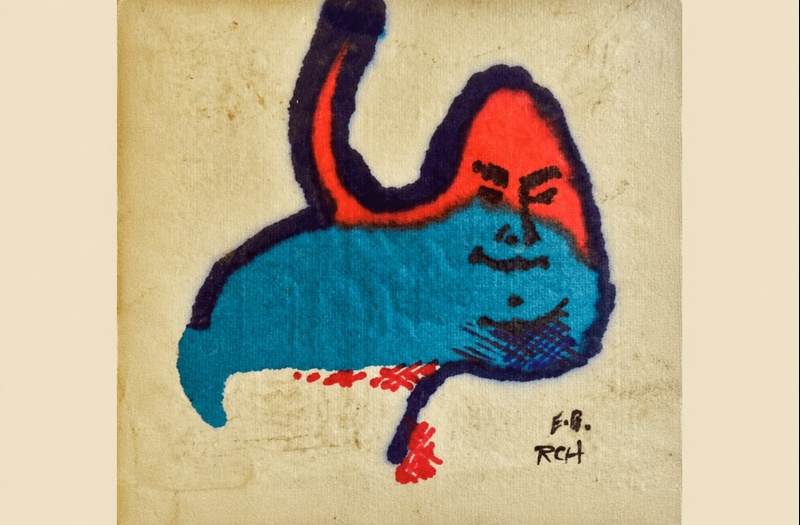
Phantasmagoric art is the artistic practice of restoring possibility wherever an ideology has mistaken its own model for reality.
There is something eerie about our times. Mark Fisher’s book The Weird and The Eerie attempts to explain the peculiar emotional atmosphere we find ourselves in. The eerie occurs when something that should be present is absent or when something absent seems to possess agency. Think about a deserted village or an abandoned shopping mall. Where are the people? Or think about how modern capitalism works. Agency has migrated from individuals to abstractions. Corporations act, markets move, algorithms decide, the economy demands, shareholders expect. Once again, where are the people?
When we think we have all the answers, the future becomes haunted by abandoned possibilities. Possibilities become ghosts. If capitalism tells us there is no alternative then imagination doesn’t disappear, it lingers like a ghost. We feel something is missing without being able to name it. The result is an eerie melancholy.
Everything flips, over and over. I cry, I laugh. I laugh, I cry. I think I understand only to discover I don’t. Life constantly reverses my expectations. I’m not even aware of my own blindness.
Ironically, something like this happened a hundred years ago when Lenin took over Russia. Boris Pasternak’s masterpiece Doctor Zhivago captures how the familiar realities of pre-revolutionary Russia suddenly dissolved into a strange, upside-down world where logic was upended and individual identity was forcefully subjugated by the state. The inversion of truth where language and logic lost their traditional meanings: the abrupt collectivization of private space, the uncanny dreamlike coincidences where characters constantly collide, separate, and cross paths across the vast, war-torn Russian landscape, and the bizarre visual metaphors like Varykino, “Ice Palace,” a frozen house buried in pristine yet hostile snow as a stand in for a beautiful but utterly frozen and unlivable new world.
Pasternak deliberately contrasted the harsh, bloody realities of the Russian Civil War with the abstract, utopian promises of the Bolsheviks. This intense gap between political theory and lived human tragedy is what creates the distinctly surreal, nightmare-like atmosphere that permeates the book. Because Pasternak chose to highlight this disorienting individual experience over idealized Soviet patriotism, the book was deemed highly subversive and banned in the USSR for decades.
Censorship by the left, “socialist realism,” became the official state-mandated art style that Andrei Sinyavski (aka Abram Tertz) critiqued in his scathing essay “On Socialist Realism.”
“Right now I put my hope in a phantasmagoric art, with hypotheses instead of a Purpose, an art in which the grotesque will replace realistic descriptions of ordinary life.” Andrei Sinyavsky, On Socialist Realism.
Sinyavsky’s statement is one of the clearest manifestos against what he saw as the tyranny of official certainty. Sinyavsky wants “hypotheses” instead of “Purpose.” Fisher wants futures instead of inevitability. Both reject historical closure, one artistically, one politically. Both think imagination has become imprisoned. Imagination exceeds ideological certainty. The present is haunted by possibilities that exceed the social order’s imagination.
We see the emergence of certainty by the right today in schools, libraries, museums, and public places. One can’t help but wonder if it will metastasize into a full blown version of “capitalist realism,” a cousin to the “socialist realism” abhorred by Sinyavsky and parodied in his Fantastic Stories published under the pseudo name Abram Tertz. Phantasmagoric art is the way out of this maze of certainty we continually get trapped in.
Phantasmagoria suggests dreams, hallucinations, distortions, impossible events, and transformations. These are not escapes from reality. They are ways of revealing realities that ordinary realism cannot.
America has been in the midst of the current surreal atmosphere since long before the rise of Donald Trump. The late British philosopher Mark Fisher coined the phrase “capitalist realism” in his 2009 book Capitalist Realism: Is There No Alternative? He was addressing the neoliberalism that begin in the late 1970s in the U.S. and the U.K.
The classical liberalism of Adam Smith and David Hume understood that not all government duties are bad, that a strong foundation in human morality is a necessary check on unrestricted self-interest and harmful human impulses, and that rigid free market worship ignores the moral and institutional guardrails necessary for a healthy society. A “mixed economy” strikes a balance between equity and efficiency and leaves room for the imagination.
Neoliberalism shrinks everything to the free market (think Ayn Rand, Friedrich Hayek, Milton Friedman). It took over politics and culture with Ronald Reagan and Margaret Thatcher. Donald Trump came late to the party, exploited the populist right, established his cult of personality, and promoted a carnivalesque culture. Neoliberalism has never been “free market” for everyone. It’s generally been socialism for the rich and capitalism for the poor.
Which brings me to the 2023 Nicolas Cage movie Dream Scenario. I confess that I’m a big fan of Cage. This movie is not a sweeping panorama of love, history, revolution, and breathtaking landscapes like Doctor Zhivago. But, it is a relevant movie for our times.
Dream Scenario is a surreal dark comedy directed by Kristoffer Borgli that stars Nicolas Cage as Paul Matthews, a mild-mannered university professor whose life is thrown into turmoil because of the unexpected consequences that occur after people tell him that he keeps appearing in their dreams. That single impossible premise allows the film to investigate modern life more deeply than straightforward realism could.
Initially harmless and even flattering, his dream fame soon turns disturbing as the dreams become nightmares. He is transformed into a global pariah. The movie blends satire, psychological horror, and absurd humor. It shows how celebrity, social media, collective imagination, identity, and the frightening loss of control over one’s public image can occur in our consumer oriented advertising driven technological world.
In a way the movie mirrors our hyper-polarized political discourse and internet “cancel culture”, where nuanced truth is discarded, and digital tribunals execute rapid, disproportionate social exile based on perception rather than evidence. The movie also reflects a post-truth reality where political figures and ordinary citizens alike are reduced to flattened, memetic symbols, demonized or idolized by echo chambers that care more about emotional projection than factual reality.
Throughout the movie everything flips. Paul is an enigma, a celebrated dream friend, then a monster inside a night terror. His world turns upside down for reasons he can’t understand is isn’t responsible for. The story suggests that life constantly reverses our expectations. We are often the least aware of our own blindness.
It’s wonderfully surreal especially the beginning scene. It is dream logic but it resonates with how our world feels today. Paul thinks he’s affecting everyone else, only to realize that he himself is the real victim.
In the psychedelic era of the 60s people assumed every mystery concealed a profound secret. Perhaps a mystery is just a mystery. The painful discovery is that we often misunderstand our own place in the world.
Dream Scenarios is full of emotional reversals. It becomes a universal story of misunderstanding. Anyone who has ever embarrassed themselves, been misunderstood, realized they were wrong, or watched public opinion suddenly turn will recognize the hubris of having all the answers.
Paul is trapped inside a narrative he didn’t create. It’s a sick joke. The “joke” is not merely a mistake. It is the human condition of believing we fully understand ourselves before discovering that we do not.
Neoliberalism prevents solidarity, the coming together of people to change things. GDP goes up while the quality of life for the people goes down. A quantifiable metric shows things are getting done when they aren’t. We are one financial crisis away from another turn of the merry-go-round.
Human beings seem to crave narratives that make a bewildering world feel coherent. Sometimes that narrative is supplied by religion. Sometimes by nationalism. Sometimes by Marxism. Sometimes by markets. Sometimes by technology. Sometimes by social media.
Each tells us “This is how the world really works.” Sinyavsky and Fisher tell us we should distrust every system that speaks with that kind of finality. The alternative isn’t chaos. It is perpetual imaginative openness.
“As far as the laws of mathematics refer to reality, they are not certain; and as far as they are certain, they do not refer to reality.” Einstein, Geometry and Experience
Einstein was not a phantasmagoric artist. He believed deeply in an intelligible universe. But he also believed that our conceptual frameworks are human constructions, tested by experience rather than guaranteed by reason alone. Einstein himself was sympathetic to democratic socialism. In his essay “Why Socialism?” he argued that capitalism produced alienation and inequality.
This is why Dream Scenario feels so contemporary. It isn’t merely a satire of “cancel culture” or viral fame. It is a phantasmagoria in Sinyavsky’s sense: a dreamlike hypothesis that exposes the instability of all fixed identities. Paul is never simply “the real Paul.” He is continually recreated by the dreams and therefore the interpretations of others.
The film suggests that our social reality is always, to some extent, phantasmagoric. We live not only among facts but among stories, symbols, fears, fantasies, and projections. Sinyavsky would likely have recognized in Dream Scenario exactly the kind of grotesque, questioning art he hoped would replace art that merely confirmed what everyone was already expected to believe.
Very well reasoned & written. Bravo.
Again, superb writing here. I enjoyed your asides, that always directed me back to the central theme. I am tackling a sort of phantasmagoric piece of art right now for the Ekphrasis I am doing, my role as a reactor to the painted work, and it feels better to view it laying on its side. So your piece here is quite timely. Thanks.