
“A word is not the same with one writer as with another. One tears it from his guts. The other pulls it out of his overcoat pocket.” Charles Peguy
“Trust the man whose heart is moved, the man whose withers can still be wrung.” Herman Miller
To read or not to read, that is not the question. Almost everyone reads something somewhere sometime. Roughly 80% of Americans are functionally literate. Unfortunately that number is not growing and may be decreasing. That’s a serious problem. But, what about those that do read? How do they read and what good does it do them?
I’m only concerned here with those who read literature (novels, short stories, plays, poetry) annually, about 40% of the adult population. About 60% read at least one book of any genre per year.
For this limited audience that reads a little or a lot, to read or not to read isn’t the question. How to read is the question.
Samuel Taylor Coleridge in his Notes and Lectures upon Shakespeare [and Some of the Old Poets and Dramatists: With Other Literary Remains of S.T. Coleridge, Volume 1] divides readers into four classes:
“Readers may be divided into four classes:
I. Sponges, who absorb all they read, and return it nearly in the same state, only a little dirtied.
II. Sand-glasses, who retain nothing, and are content to get through a book for the sake of getting through the time.
III. Strain-bags, who retain merely the dregs of what they read.
IV. Mogul diamonds, equally rare and valuable, who profit by what they read, and enable others to profit by it also.”
Coleridge’s four classes of readers are witty. They ask what happens to experience once it enters the mind.
The sponge absorbs everything. The sponge-reader is learned, perhaps even impressive, but largely passive. Information is soaked up and repeated with little transformation. Coleridge’s amusing phrase “a little dirtied” suggests that mere repetition often degrades what was originally alive or subtle. Books are stored away and lose their capacity as catalysts for thought. This is not the same as organizing them in a bookcase where they can be easily retrieved when the mind is awakened by a phrase or an idea. In that case the book is still alive and working. Sponge readers might be people who endlessly quote, repost, summarize, or accumulate facts without synthesizing them. They know about ideas but rarely metabolize them.
The sand-glass lets everything run through. This is the reader of distraction and consumption. Books are reduced to time-filling devices. Nothing remains after the final page because the reader was never really engaged. Coleridge saw this as spiritually empty. Reading becomes analogous to scrolling or passing idle hours. Books are like the notches on a gun barrel that signify victory counts of lives long forgotten. The image is brilliant because the sand-glass appears active, sand is moving, yet nothing is actually accomplished. It is motion without transformation.
The strain-bag keeps only the dregs. This could be Coleridge’s harshest category. Some readers distort books by retaining only the sensational, vulgar, or confirmatory parts. They miss nuance and preserve residue. Instead of enlarging consciousness, reading becomes no more than a filter for prejudice, gossip, ideology, or triviality. This is the most threatening for writers who take their work seriously, who strive to deepen readers’ perception.
The Mogul diamond reader is rare because this person does more than absorb or remember. They refine, refract, and re-create. Reading becomes an active encounter between text and imagination. These readers produce insight not only for themselves but for others. Imagination is not passive reception but creative participation in reality. The great reader becomes almost a co-author of meaning.
There is something democratic and humbling in Coleridge’s scheme. No one is permanently fixed in one category. A person may be a sponge in history, a sand-glass with newspapers, a strain-bag in politics, and occasionally, with a beloved book encountered at the right moment, become a diamond.
Reading is not fundamentally about books at all. It is about the attention one brings to existence itself. The one qualification good readers have is a thirst for good books. It is the hungry and thirsty who will eventually decide the future of any author’s work.
A king who doesn’t read well, who thinks he lives a life of luxury, will never know true happiness. As Pascal said in his Penses: “Let us leave a king all alone to reflect on himself quite at leisure, without any gratification of the senses, without any care in his mind, without society; and we will see that a king without diversion is a man full of wretchedness.”
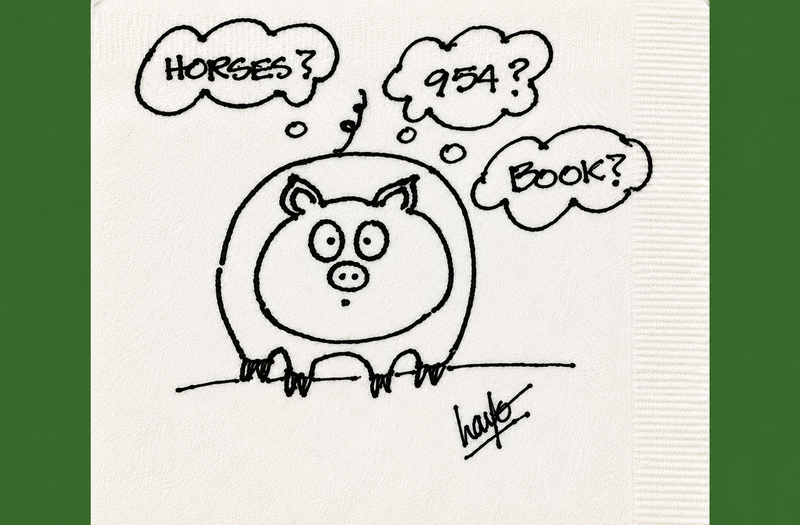
When I put this blog together and found the cocktail napkin up top by Jack Haye, I laughed at how prescient it was some forty to fifty years ago. That’s the amazing thing about the hundreds of pieces of napkin art now stored at the Kelley House Museum in Mendocino. We really do live in an ouroboros-like world where history does not repeat itself but often rhymes (Mark Twain).
That 954, think of it as an enneagram. It combines 9 (receptivity, peace, diffusion of ego, openness) and 5 (intellectual depth, observation, inwardness) and 4 (imagination, emotional nuance and symbolic sensitivity). That combination naturally inclines someone toward the Mogul diamond ideal, but the fit is not perfect. I’ll leave you to figure that one out.
In the meantime, read a good book.