
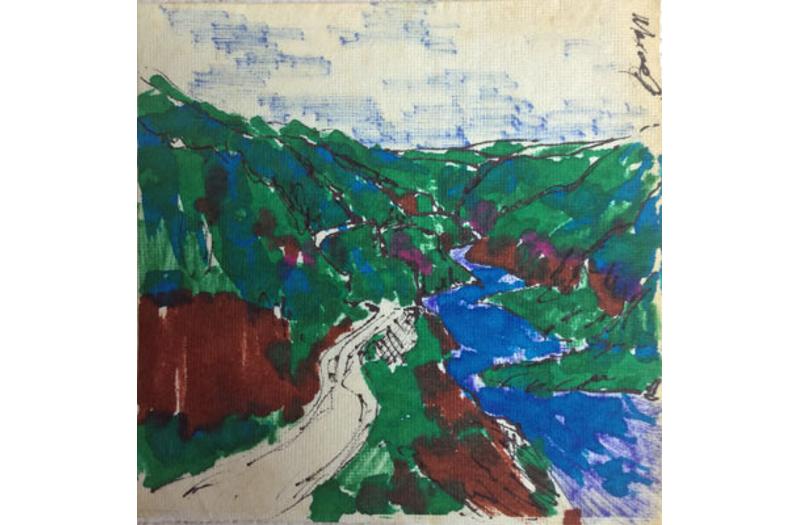
“My house . . .” said Cosimo, and gestured around, at the highest branches, the clouds, “my house is everywhere, everywhere I can climb, going up . . .” The Baron Of The Trees, Italo Calvino
In 1958 when I was twelve years old I visited my great uncle Lewis Foster who worked for Walt Disney Studios. I met some famous movie and TV stars including the Mouseketeers, Sebastian Cabot, and Fess Parker. I sat in the studio and watched one part of A Light In the Forest filmed. It was a kid’s dream. Little did I know I’d live out my life in Northern California’s redwood forest where some other scenes from that movie were filmed. I moved to Mendocino a decade or so after my visit and never looked back.
While set in colonial Pennsylvania, some of The Light in the Forest was filmed in the old-growth redwood forests of Northern California. The immense scale and timeless atmosphere provided a powerful visual stand-in for an earlier America. The towering forests along the Mendocino/Humboldt coastline echoed the deep, ancient landscape character of the movie. The immense trunks and filtered light conveyed antiquity and continuity, a visual shorthand for “frontier before settlement,” even if geographically inaccurate. Unlike tangled Eastern forests, many redwood groves are open at ground level. This allowed for tracking shots of riders, marches, and encounters that would have been difficult to stage elsewhere. Coastal fog and vertical light beams created a soft, almost spiritual tone that reinforced the film’s themes of belonging, displacement, and moral searching.
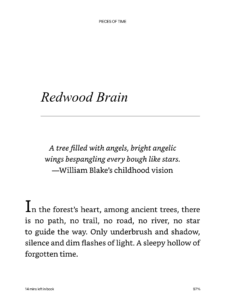
The forest surrounds me and affects me in multiple ways. In Pieces of Time I wrote, Redwood Brain, to describe how living in the forest sets my brain in motion. The forest is a common theme in poems, novels, movies, and essays.
Dante’s Inferno begins:
“Midway upon the journey of our life
I found myself within a dark wood,
for the straight way had been lost.”
Dante’s forest is a moral labyrinth to escape.
Pablo Neruda’s poem Lost in the Forest describes the human mind wandering through a dense, beautiful, and disorienting terrain of existence. Being lost is not merely confusion but a condition of awareness and transformation.
Lost In The Forest
Lost in the forest, I broke off a dark twig
and lifted its whisper to my thirsty lips:
maybe it was the voice of the rain crying,
a cracked bell, or a torn heart.
Something from far off it seemed
deep and secret to me, hidden by the earth,
a shout muffled by huge autumns,
by the moist half-open darkness of the leaves.
Wakening from the dreaming forest there, the hazel-sprig
sang under my tongue, its drifting fragrance
climbed up through my conscious mind
as if suddenly the roots I had left behind
cried out to me, the land I had lost with my childhood—-
and I stopped, wounded by the wandering scent.
*from allpoetry.com
Neruda’s forest is existential immersion to inhabit.
In past blogs like the Lowly Tan Oak at this LINK and a review of John Fowles’s essay on The Tree HERE, I made a few observations about the forest. One particular novel comes to mind every time I walk in the woods: Italo Calvino’s The Baron in the Trees. This novel explains why I moved to the Mendocino coast. It’s the story of Cosimo Piovasco di Rondò as told by his brother Biagio. After a fight with his father, Cosimo climbs up a tree and promises to never set foot on earth again, and he keeps his promise until the very end.
Baron Arminio Piovasco di Rondò, Cosimo’s father says to his son: “Rebellion cannot be measured by yards … Even when a journey seems no distance at all, it can have no return.” This observation is the key to the book.
Calvino’s book is not really about a boy in the trees although you might think it is if you focus on the marvelously imaginative scenes depicting what life in the trees might actually be like. Calvino’s story brings to mind Voltaire’s Candide with Calvino’s hilarious escapades of Cosimo, but Candide finds out his truth at the end of the story while Cosimo discovers his at the beginning. The book is about how a single, seemingly small refusal can open an entirely different way of being in the world. Cosimo’s rebellion is immeasurable because it is inwardly infinite. The distance Cosimo travels is not physical, it is moral. He never leaves his family’s estate in any conventional sense. He lives in the trees just a few yards off the ground. But, his father understands immediately that the act is irreversible. It is a rebellion against obedience that redefines Cosimo’s relationship to society. Cosimo has chosen a different mode of existence. The rebellion is not where he goes, but how he will live from now on. A true decision is existential, not spatial.
The Baron in the Trees is part of a trilogy called Our Ancestors. The other two novels are The Cloven Viscount and The Nonexistent Knight. All three works present a protagonist of noble origin in some sort of fantastical predicament. The Viscount, after a cannonball injury, becomes two people: one representing his bad half and one his good half. The Knight portrays the faith, honor, and chivalry of a man who blindly follows his king but in so doing he loses the essence of his being. “I wanted to make a trilogy of them, about being realized as a human being: three levels of approach to freedom,” said Calvino in a preface to the three stories.
Calvino died far too soon at 61 in 1985. His novels and short stories decry the social ills of consumerism, out of control capitalism, environmental degradation, the tragedy of being alienated from nature and from each other. I miss his sharp eye and passionate pen in today’s out of control world. Which brings me to the reasons I moved to the forest.
There were many. Family tragedies (see my novel Behind The Locked Door). A connection with Camus’s existential angst, the human wandering through a universe that doesn’t provide maps. I first read Camus’s The Stranger in my college French class and went on to read everything Camus. Richard Brautigan’s poetic openness to strangeness in In Watermelon Sugar gripped hold of me and never let go. John Fowles’s curiosity where being lost invokes wonder, not defeat. I first read him in V.I. Wexler’s college English class. But mostly, I think it was something deep inside like Cosimo’s choice of an elevated habitat from which a human being can redesign how to live in the world.
Which brings me back to A Light In The Forest. The movie had a greater impact on me than I realized at the time. A Light in the Forest is a 1958 Disney movie that explores themes of identity, culture, and the relationship between civilization and nature. It’s based on the novel by Conrad Richter and tells the story of a young boy named John (or True Son) who is captured by Native Americans and raised within their culture. When he is eventually returned to his white family, the film delves into his struggles to reconcile his two identities.
In The Baron In The Trees Calvino imagines the space between worlds as a deliberate philosophical perch, while A Light in the Forest portrays the same condition as a historical and emotional reality. Together they show that identity can take shape not only in one culture or another, but also in the difficult, enduring act of standing between them.
Cosimo’s trees give him a new vantage point. He sees society clearly precisely because he is slightly removed from it. True Son undergoes a similar transformation. Having lived within Indigenous culture, he perceives settler customs as strange rather than “normal.” He embodies a double vision the surrounding society lacks. Calvino’s central insight is that distance, even a few feet, can produce moral and intellectual clarity. Cosimo climbs to gain perspective. True Son is thrust into it.
Distance, even a few feet, can produce moral and intellectual clarity. Both works reject the romantic fantasy of leaving the world behind. Instead they explore how to remain ethically present without surrendering one’s lived truth. As we now know, True Son’s indigenous world lost the battle (but not necessarily the war, it ain’t over ’til it’s over). If Cosimo’s goal was to defeat society, he also loses. He doesn’t overturn the aristocratic hierarchy, he doesn’t change property relations or social conventions or the march of modern history. His rebellion doesn’t reshape the external world. But, if his goal is to remain free, he succeeds. He refuses to live by rules he does note accept. He builds a life entirely in the trees. He doesn’t drop out. He reads, loves, debates and acts without descending from the trees. Measured by integrity rather than influence, he triumphs.The “enemy” Cosimo confronts is less his family or class than what one might call the gravity of habit, the pressure to live as everyone else does simply because that is how things are done. A life can be meaningful even if I leaves no system behind. Cosimo’s “battle” is to live deliberately without retreat and he never retreats. Cosimo did not lose his battle with the world; he simply fought a different kind of battle, one measured not by changing society, but by remaining unwaveringly himself within it.
The forest affords us a chance to live as we like. Whether Dante, Voltaire, Thoreau, Neruda, Camus, Brautigan, Fowles, True Son, Cosimo or you or anyone, Mark Twain said it best: “You pays your money and you takes your choice.” (The Adventures of Huckleberry Finn)
What an adventure you had in Los Angeles! We could only dream of having the chance to peek inside that world. But we all can slip into a forest and lose the world. When the Japanese developed the idea of forest bathing in the 1980s my first thought was – duh. Of course. But, bathing is an apt word. When I enter a forest I feel like I have plunged into a serene pool that touches all my senses and calms the restless cares of life.
Thanks Carol. Yes, I was lucky to have that opportunity and doubly lucky to be able to live where I live. I don’t take it for granted. I appreciate your taking the time to comment.
Thank you so very much for another great story.
By the way, may I please ask what you think of “Big Sur and the Oranges of Hieronymous Bosch.” by Henry Miller.
Kinda forest and kinda brought me here.
You just give such wonderful overviews and quotes of what you have read, i have to ask. : )
Wow, I cannot answer since I haven’t read that book but a brief look makes me want to read it. I’m somewhat familiar with Miller and his early development in Paris with Anais Nin and of course his steamy relationship with Marilyn Monroe. It appears his Big Sur book consists of his reflections on life after those earlier formative stages in his life. As a Brautigan fan I can’t help but think if A Confederate General From Big Sur but there is no connection at all between Brautigan and Miller. Maybe they both appreciated the natural environment of Big Sur and shared a distaste for literary and social pretension. Sorry I can’t say more but I will put that book on my list to read and get to it when I can. From a mere scratch of the surface it appears Miller and I share one thing, our desire to disconnect from the frenetic pace of the “American Dream” or an attempt to redefine it according to our own tastes. Thanks for pointing out the book to me. Miller was of my father’s generation but very different people as you can see if you read some of the early stories in my Pieces of Time.