
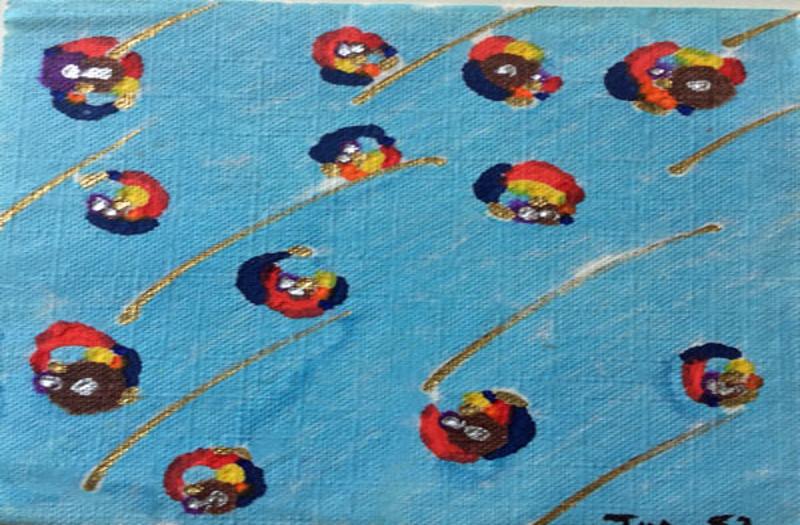
“It’s not the notes you play. It’s the notes you don’t play.” Miles Davis
According to Merriam Webster: Interstices are small, narrow gaps, crevices, or spaces between closely spaced objects or parts commonly referring to cracks in walls, spaces between atoms, or intervals in time. Common synonyms include gaps, crevices, chasms, intervals, and lulls.
Imagine a foggy Mendocino morning. The Pacific rolls against dark rock, the redwood forest rises up behind the cliffs. An osprey hovers above the water. A salmon moves methodically upriver while the fog drifts between the ocean and the trees.
This is a landscape made almost entirely of interstices: forest and prairie, cliff and ocean, fog and sunlight, freshwater and saltwater. It is not surprising that such landscapes generate stories, myths, and literature because edges naturally invite imagination.
In his book “Edges (originally published in 1976), historian and sociologist Ray Raphael explores the lives of people who choose to live on the “edges” of mainstream society. I moved to the Mendocino coast to run a restaurant and immediately recognized my customers, neighbors and friends as cohabitators of the edge.
I began to think in the way magical realist authors write. Reality begins to loosen precisely in those marginal spaces where people drift between identities and meanings, places the Cuban author Alejo Carpentier called lo real maravilloso (the marvelous real). Magical realism arises naturally in landscapes where mountains meet the sea, where indigenous cosmologies meet a western world view. Cultural and ecological interstices generate the marvelous.
Strange events happen most often in places like riverbanks, shorelines, bridges, forest edges, desert borders, and old houses with hidden rooms. They are places where systems meet and overlap. In ecological language they are ecotones. In anthropology they are liminal spaces. In literature they become the doorways of magic.
The Mendocino coast is a magical-realist landscape. It is a landscape built entirely of edges. Writers like García Márquez or Cortázar would immediately recognize such a place as ideal for stories where birds carry messages from another realm, where fog hides forgotten histories, where rivers remember the past. In such a place, reality already feels slightly porous.
The gap is a structural feature of being human. It is the space between what is possible and what becomes actual, between thought and action, intention and realization, between what you feel and what you can express. Gaps can be cognitive (between experience and understanding), existential (between life and death), creative (between what is said and what is implied), moral (between not knowing what’s right but having to choose anyway), and perceptual (the actual medium of consciousness itself). The gap exists because we are not identical with reality. Everything depends on how you relate to it.
Poets, authors, philosophers, scientists, anthropologists, architects, urban theorists, naturalists, musicians, and many other thinkers know this. I first thought seriously about interstices when I wrote The Art Of Empty Spaces inspired by Valeria Luiselli’s fine book Sidewalks.
Some seek to fill empty spaces, some to avoid them, some to embrace them. In his bleak poem Aubade Philip Larkin fears the gap:
The mind blanks at the glare. Not in remorse
—The good not done, the love not given, time
Torn off unused—nor wretchedly because
An only life can take so long to climb
Clear of its wrong beginnings, and may never;
But at the total emptiness for ever,
The sure extinction that we travel to
And shall be lost in always. Not to be here,
Not to be anywhere,
And soon; nothing more terrible, nothing more true.
T.S. Eliot’s Hollow Men get lost in the gap:
Between the idea
And the reality
Between the motion
And the act
Falls the Shadow
For Thine is the Kingdom
Between the conception
And the creation
Between the emotion
And the response
Falls the Shadow
Life is very long
Between the desire
And the spasm
Between the potency
And the existence
Between the essence
And the descent
Falls the Shadow
For Thine is the Kingdom
In Death Without Dread the philosopher Walter Kaufmann clarifies the gap away by removing the mystery that gives the gap its emotional power. His argument is much like the one Epicurus used centuries ago: death is nothing to fear because “where death is, I am not; where I am, death is not.” Kaufmann doesn’t inhabit or use the interstice, he dissolves it by showing it was partly an illusion created by confused thinking.
Zen Buddhism goes even further. It dissolves the gap by showing that the division between here and there, idea and act, self and world is not as real as it seems. There is only the seeing of the idea and the doing of rhetoric act, no space in between, unless you create it.
Albert Camus said the universe responds to our desire for meaning with silence. We must create our own meaning through action.
Leonard Cohen in Anthem said:
Ring the bells that still can ring
Forget your perfect offering
There is a crack, a crack in everything
That’s how the light gets in.
Richard Feynman called gaps the open channel, the space where discovery can take place:
What, then, is the meaning of it all? What can we say today to dispel the mystery of existence? If we take everything into account, not only what the ancients knew, but also all those things that we have found out up to today that they didn’t know, then I think that we must frankly admit that we do not know. But I think that in admitting this we have probably found the open channel. Feynman, Richard P. The Meaning of It All: Thoughts of a Citizen-Scientist
John Fowles when he commented on his novel The Magus said:
… the Magus is trying to suggest to Nicholas that reality, human existence, is infinitely baffling. One gets one explanation – the Christian, the psychological, the scientific … but always it gets burnt off like summer mist and a new landscape-explanation appears. He suggests that the one valid reality or principle for us lies in eleutheria – freedom. Accept that man has the possibility of a limited freedom and that if this is so, he must be responsible for his actions. To be free (which means rejecting all the gods and political creeds and the rest) leaves one no choice but to act according to reason: that is, humanely to all humans.
Virginia Woolf in her work implied that we are made up of the gap, of interstices. In works like To The Lighthouse she dissolves the boundary between thought and reality, the line between moment and memory. She gives us continuous flow, where the between is everything. The interstice is no longer a gap, it’s the fabric of experience.
Many thinkers have noticed that thinking often occurs between things: between perception and memory, between emotion and logic, between competing ideas. The physical brain mirrors that idea. Thought emerges in the gaps between neurons. Every memory, idea, or image you have ever had passed through those minute gaps between cells. In that sense, the mind itself is an architecture of interstices.
Imagine consciousness as something like a coastline. From far away it looks smooth and continuous. But, up close it consists of countless small inlets, gaps, transitions, shifting boundaries. Thought may work the same way: a continuous experience built from innumerable tiny intervals.
If you think about the Mendocino coast, it also has this rhythm of interstices: waves breaking, silence, another wave; fog drifting in, clearing, returning; wind in the redwoods, stillness, wind again. Nature itself moves through intervals. A writer like Woolf might have loved such a landscape because it embodies exactly what her novels explore: life unfolding in the spaces between events.
Thought does not emerge from a single neuron. It emerges in the spaces between networks, the fluctuating gaps where patterns can recombine. In a sense forests have ecological interstices, coastlines have tidal interstices, brains have synaptic interstices. Inside those tiny gaps may be where new ideas begin.
The flight was punctuated by interstices between soft white clouds and a brutal blue sky pierced by violent sunlight that blinded Eric when it came through the window. From my novel: Behind The Locked Door
Thank you,
I like this,……… ….directly from inbetween cell to cell in my brain.
Thanks, I like to read between the lines.