
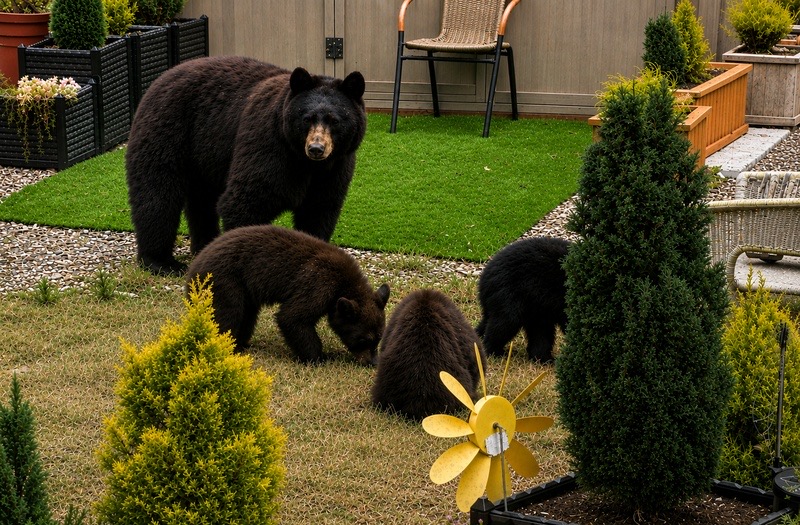
When I grew up in the 40s’ and 50s’ I listened every Saturday morning to the Big John and Sparky show. The theme song (The Teddy Bear’s Picnic, see below) blasted from my radio as I lay in bed and waited for the current week’s show to start. I listened to the song and dreamed of bears. Black bears are very common on the Mendocino Coast. We’ve seen a few on our property every year over the fifty years we’ve lived here. The three cubs in the photo I took on July 9th are probably about 6 months old. Black bear cubs are usually born in January or February. The mother bear is very protective of her cubs and for that reason we stayed inside the house and enjoyed the view. The mother bear remained calm and relaxed and allowed her cubs to forage. They stopped and tested the apples on one of our trees. The apples are not ripe so the bear family quickly moved on. They most likely live somewhere in the neighborhood. I’m sure we will see them again especially when the apples ripen.
We like to walk on our property and observe the trees, wildflowers, plants, and birds. It’s important to stay aware of your surroundings, give bears plenty of space if you see them, never approach cubs, and avoid walking directly into dense brush where you might surprise them. We’ve only had a couple of problems, both our fault. We had an outside refrigerator where we kept some excess items. A young bear broke into it one night and stole a pound of butter. When I opened the door the bear was sitting on his haunches eating the butter. He immediately climbed a redwood tree up into the high limbs and stayed there until it was clear that I was gone. Once we left some power bars in our car. A bear broke into the car and took all the bars, unwrapped them, ate them, and left the wrappers in a neat pile. There was minimal damage to the car. The bear was surprisingly careful and neat.
In our area bears eat berries, acorns, insects, fish if they can get them in the shallow streams and human food if you are reckless enough to leave it out. We have a compost but have decided to do away with it. Human scraps are not good for the animals. and we don’t want to encourage or discourage bears. This is the time of year when family groups begin ranging more widely. Over the next several months the cubs will learn where food sources are. If they repeatedly find bird seed, garbage, pet food, fruit trees, or compost, they’ll remember. If they consistently find nothing, they’ll spend less time visiting. Removing attractions keeps them wild.
Our ecosystem must be doing well if a healthy mother can raise three cubs. That’s encouraging. These bears are probably traveling a route they’ve used for generations, moving between forest cover and seasonal food sources. Our yard is simply one stop on their evening foraging circuit. Hopefully they find little of interest and move on. That’s best for them and for us. In the spring they feed on grasses, forbs, insects, and fresh vegetation after emerging from their dens. In the summer they eat berries (blackberries, huckleberries, salal berries), insects, and whatever fruit begins to ripen. Late summer through autumn they eat almost constantly to build fat reserves for winter. During this time they may consume 15,000 to 20,000 calories per day or more. When our apples ripen, the trees become a free buffet.
Forbs are one of the most important foods for black bears in spring, when they first emerge from their winter dens. At that time, they are looking for tender, protein-rich new growth rather than fruit or nuts. Some common forbs eaten by black bears on our coast include cow parsnips, miner’s lettuce, redwood sorrel, skunk cabbage, clovers, dandelions, vetches and native peas.
Black bears are surprisingly good climbers. A mother bear can climb into the canopy and sit on large branches while eating. She can pull branches and even break them. She knocks dozens of apples to the ground where the cubs happily clean them up. They share the apples with the deer and birds including the wild turkeys that come through in the summer and fall. We’ve come to accept that we must share our small apple crop with the local wildlife. If we pick the apples as soon as the ripen we can usually get enough for a few pies, crisps, and some jars of applesauce while there are enough left for the animals. Our yard is a kind of meeting point between the cultivated and the wild.
I don’t know where these bears call home. I’ve read they roam 2-5 miles on an evening of foraging and that they may use 10-30 miles of habitat over a whole season. A typical routine might be to rest in dense forest during the day, start moving in the late afternoon, visit berry patches, check apple and fruit trees, continue through neighboring properties, and return to forest cover before sunrise. Black bears have excellent memories. If a food source has paid off in previous years, they often revisit it around the same time each season.
The mother bear appears very relaxed. She allows the cubs to spread out and forage while she periodically looks up and scans the surroundings. That’s the behavior of a bear that knows the area well. If she was simply passing through unfamiliar territory, she’d likely keep the cubs much closer and spend more time on the move than stopping to feed.
I spend a lot of time observing birds, flowers, mushrooms, fog, and streams around our property. That kind of quiet attentiveness is actually an advantage. People who move slowly and notice their surroundings are much less likely to surprise wildlife than hikers charging down a trail.
Millions of people live in and explore black bear country across North America. Serious attacks by black bears are extremely rare. On the Pacific Coast, the overwhelming majority of encounters end exactly as mine did yesterday: the bears forage, decide there’s nothing worth staying for, and move on.
Don’t stop enjoying your forest. Walk with the awareness that you’re sharing it with one of its oldest inhabitants. Think of the bears not as neighbors you need to fear, but as neighbors you should respect just like you would the ocean on a rough day. It’s a place of great beauty, provided you pay attention to the conditions. Make sure to follow some basic rules as set out by the U.S. Forest Service.
Black bears have been part of the California landscape for a very long time, some say thousands of years going back into the Holocene. They originally shared the habitat with grizzly bears but the last grizzly in California was killed in the 1920s. There is no need to fear these beautiful animals if you behave properly around them. If you come across a bear picnic in the forest, make a note of it and enjoy the scene.
NOTE: One of my readers contacted me with her experience which a bit different than mine: “3 cubs! That’s unusual. I have trouble with them breaking in, as do quite a few of my neighbors. Down here in Albion, they’ll tear doors off sheds and trailers, break windows, etc. to get at food, refrigerators, freezers, etc. My neighbor lives in a mobile home, and one night when he finished cooking his dinner, and came back into the living room to eat it, there was a bear in the living room waiting for him! Between my hubby and I, over the past few years, we’ve seen 8 bears at our place that we can tell apart, so there are probably more than that.” For a cautionary tale try this link: “It Would Not Be Deterred.”