
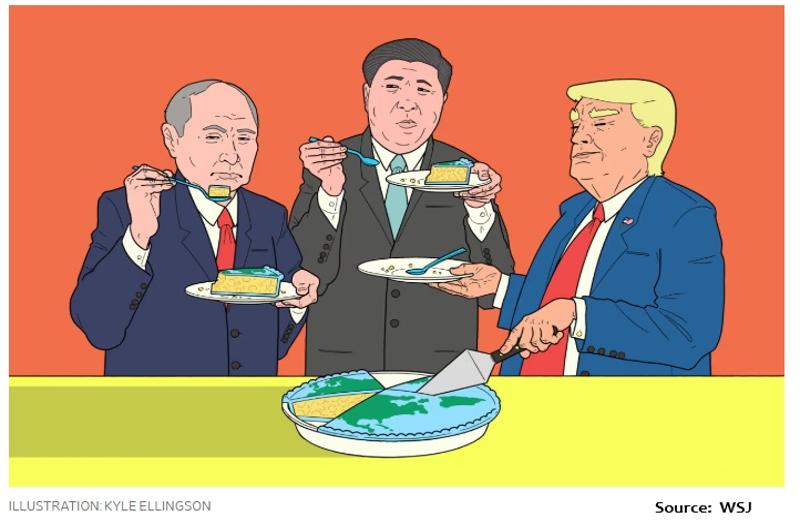
With the news from Venezuela this morning (January 3rd, 2026) we refer you to our good friend over at Global Macro Monitor. The crib notes for those who won’t or can’t read this important post in all its detail are pasted below. For the entire article click on this LINK: Back To Yalta: A Great Power Carve Up.
Trump’s foreign policy represents a break from the multilateral traditions of the post-World War II order, favoring direct negotiations and economic leverage over alliance-based diplomacy. This shift echoes the compromises made at Yalta and the fragile peace efforts after World War I, both of which had long-term geopolitical consequences. If European nations do not take proactive steps toward greater autonomy in defense and diplomacy, they risk becoming passive participants in a new great power realignment. The historical lesson is clear: in an era of shifting alliances, European nations must assert their sovereignty or risk being dictated by external forces once again. So, here’s the deal: Putin gets Ukraine and…Xi gets Taiwan, and Trump gets Canada, Greenland, and the Panama Canal? God help us. (source: Global Macro Monitor)
A short history of U.S. Venezuelan relations follows to put today’s actions in perspective:
From the early 20th century until 1958 America focused on securing oil flows and supporting anti-communist governments in Venezuela even if meant aligning us with authoritarian governments such as Marcos Pérez Jiménez. Venezuela was a major supplier of oil to the U.S. during WWII and the early Cold War.
From 1958 to 1998 Venezuela became one of Latin America’s most stable democracies. The U.S. support the two-party system diplomatically and economically. Despite formal democracy, inequality and corruption grew, especially after oil price collapses in the 1980s
In 1999 Hugo Chávez came to power promising a “Bolivarian Revolution.” Chávez nationalized industries, expanded social programs and aligned with Cuba, Russia, and China. U.S. Venezuelan relations deteriorated sharply as Chávez framed the U.S. as an imperial adversary.
Nicolás Maduro, Chávez’s successor, inherited falling oil prices and deep mismanagement. Economic collapse, hyperinflation, mass emigration, and repression followed. The U.S. escalated targeted sanctions later expanding to oil and financial services. The U.S. goal was to pressure Maduro to restore democratic governance.
The U.S. recognized opposition leader Juan Guaidó as interim president in 2019 after he won an election. Maduro retained military control, the opposition unity fractured and Guaidó left the country. U.S. sanctions hurt the economy but did not dislodge the regime.’
Under President Biden U.S. policy shifted toward limited engagement. Some sanctions were eased in exchange for electoral concessions and oil-market stability.
Overnight and early this morning the United States launched large-scale military strikes inside Venezuela, including on military bases and infrastructure around Caracas, with explosions and aircraft activity reported. U.S. forces captured Venezuelan President Nicolás Maduro and his wife and flew them out of the country to face drug and other charges in the United States
U.S. President Donald Trump announced that the U.S. intends to “run” Venezuela temporarily during a transition. Venezuela’s government condemned the strikes as “military aggression” and declared a state of emergency. Maduro’s supporters remain in control at this moment and call for the return of Maduro to the country.
Reactions are pouring in internationally with some governments expressing concern about the legality of U.S. actions. This marks an extraordinary and dramatic escalation in U.S.-Venezuela relations and could have significant regional and global implications.